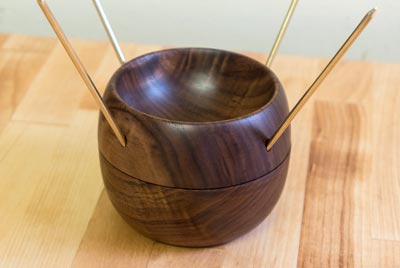

I was asked to make some canapé serving pieces for Quince. Based on the feedback from Chef Tusk, I turned more prototypes on the wood lathe. There were probably 4 or 5 iterations before finding a final shape that worked.
This is one of the earlier versions, and I’m going to skip over most of the others because it’s just more of the same (make it deeper, wider, shorter, etc.)
Prototype turned from a solid piece of pine, with 8 holes for skewers. The well in the bottom of the piece is made to hold some kind of surprise, the well in the top piece probably holds some kind of sauce or something like that.

Chef wanted to make smaller pieces for two tops, and asked if I could make them larger for 4-8 tops. Scaled up everything and made another prototype out of pine:


After making more prototypes and getting distracted by asking me to make small trays and breadboxes, we were running out of time, and they decided to go with a size that was in-between the small and large pieces. They decide to just use two pieces on the larger tables, and one on the small ones. The final shape was something like this, turned from eastern black walnut, with 4 holes for the skewers.

it begins by cutting the 8/4 (2″ thick) board down to size. I labeled each piece so I could match them up and make the grain run the same direction on both halves.

40 blanks cut to size and ready to glue up to a piece of 3/4″ plywood:

two pieces are glued up at one time to help conserve clamps

to make turning easier, each blank is cut into a disc. I made a plywood template and traced the circle onto the piece, then cut them all out on the band saw.

using a center finder, the piece is marked and then I push the point of an awl into the center. all marks from the tape are transferred to the piece of plywood.

centers are drilled out so it the pieces can be screwed onto a part of the wood lathe

here is where it got interesting because the wood turner wasn’t able to make the pieces with the plywood I’d used – it was really cheap ply and he was having problems with it de-laminating because it wasn’t strong at all. so I cut each piece off on the band saw, sanded it flat again, and then glued up a bunch of mahogany discs. this was really a pain in the ass, and it happened because I didn’t exactly understand his process. If I had only 6 pieces to make, I would have turned them myself and the plywood would have been fine, but his method was different, and he cuts quick and doesn’t work so delicately.

He didn’t have time to make the pieces to meet the deadline, but he let me use one of his lathes and I had to take a day off work and come in at 6am for a few days to make enough pieces for the quince’s re-opening.


getting somewhere with the tops:

I’ve never made so much wood shavings in my life, it was actually great to turn everything myself.

the master wood turner showing me how he would make the bowls:


after the pieces are turned, the extra wood is cut off on the band saw. there’s a jig so you don’t cut your fingers off. then each piece is sanded flat on a disc sander and ready for finishing.


at the last minute, the restaurant said they didn’t want the wood to be so dark, instead they wanted a “bronzy bronze hand-rubbed finish” whatever that means. so I made some samples to experiment with different finished. any kind of oil will immediately darken the wood. because I was seriously strapped for time, I couldn’t use a really durable finish like tung oil. I settled on a finish that was a few coats of garnet shellac, then sanded with 320 grit, and then hand rubbed with a beeswax / mineral oil paste. the garnet shellac basically fills the pores so the wood can’t absorb oil and darken, it also gives the wood an amber tone. the beeswax / mineral oil is the maintenance item, and should be reapplied as often as possible.


one of the finished pieces with the 1/8 inch brass skewers I made. there’s a step missing about drilling the holes for these skewers, which I did with 3 different sized bits and a very old ‘egg-beater’ style drill. if you drill too deep, it pokes through. too shallow and it won’t hold the rod very well. in the earlier prototypes I experimented with different angles and sizes for the skewers and decided on what was most comfortable to remove while sitting at the dinner table.


Here are some pictures of the pieces in service (amuse bouche and vegetable kabobs with parmesan sprinkled polenta cubes) , borrowed from yelp:

