

First the master is secured to a baseboard with silicone, surrounded by foam walls, sprayed with mold release, and then it’s ready to cast a polyurethane rubber mold (polytek 75-60).

Pouring the rubber:

The rubber is ready to remove after about 12 hours. Some air bubbles were formed from air escaping from wood because the top of the piece wasn’t completely sealed. This produced a less than perfect rubber mold, and the air bubbles around the text show up in the concrete.

Gold pigment brushed into the form and it’s ready to cast.


The first example is made with a fiber reinforced concrete that uses white portland cement. The mix was pigmented with 10% yellow pigment. The piece is a bit too yellow (or orange), but the gold lustre pigment stayed on the surface and it looks pretty good. A few color tests would get us closer to a real gold looking piece of concrete. The dowside of this mix is that it’s more expensive, about $70+ / 50lb. bag. Each concrete piece weighs just under 5 lbs.

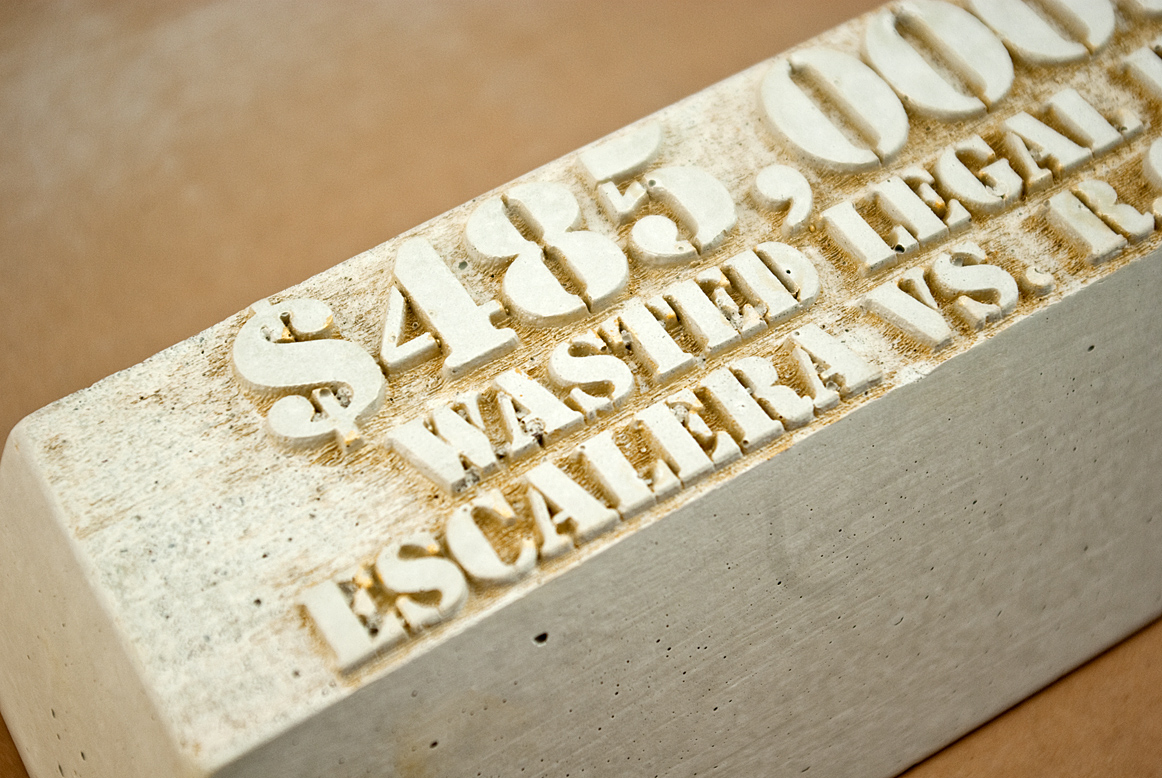
Detail of the first piece shows some of the air bubbles that weren’t vibrated out of the concrete. The air tends to get stuck in the detail, especially the periods. Most of this can be minimized I think, by using a slightly wetter mix and pressing the concrete into the details, forcing the air out.

I cast a second piece from Rapid Set Concrete Mix, which is cheaper than the fiber reinforced concrete used in the first casting. I had some gold spray paint from another project, so I sanded down some of the laser-cut texture and sprayed this one. I think this mix will suit your project better, but the gold paint looks too green. Something between these two examples would be pretty convincing as a gold bar.

I didn’t pigment the rapid set, but it picked up some of the gold that wasn’t cleaned off of the rubber after the first casting. There are fewer large air bubbles trapped in the detail on this piece, but there are more voids along the sides.
First two pieces:

They don’t look exactly like gold ingots yet, but I think we can get pretty close. I would like to see the bars smooth along the top, but sanding between the letters on the master mold isn’t easy. Otherwise I’d like to do some color tests and find a pigment formulation that looks more like gold and isn’t as dark yellow. It’s hard to see in the photos but the gold pigment on the surface really sparkles. I’ll look into the costs, but I think that can of gold spray paint is about $8, and to paint 30 ingots you’ll need probably 4 or 5 cans. It’s about the same price, or even cheaper to line the molds with gold pigment.