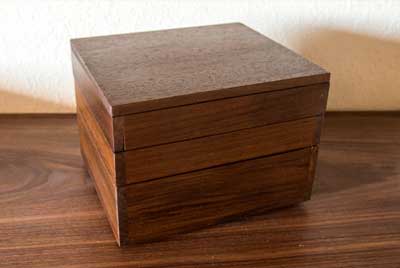

“Here is one of the few effective keys to the Design problem: the ability of the Designer to recognize as many of the constraints as possible; his willingness and enthusiasm for working within these constraints. Constraints of price, of size, of strength, of balance, of surface, of time, and so forth. Each problem has its own peculiar list.” – Charles Eames
The boxes are quite basic on the outside with no real joinery or decoration. They weren’t particularly difficult to make, and to you they might seem like a simple design. What I like about this project is the underlying complexity, and the way we arrived at the finished product after a long process of prototyping. I really enjoy the quote above and how Charles Eames was able to distill the design process into three sentences, and I think it’s an appropriate quote for this project.
- Obviously a bread box needs to hold a loaf of bread, so it should be deep and wide enough for that. “We can make the bread any size…”
- It has to sit on the table, between the two plates and not too close to the glasses on either side. At first it was a square, but it was too tight between the plates and it became a rectangle.
- The server should be able to carry it, place it on the table, and pick it up elegantly and comfortably.
- Dropping the box and the experience for the guest is carefully orchestrated and executed by the server. The box is raised up from the table, so it’s easy to pick up. The wood is relatively thin, so it’s lightweight.
- It’s very important that the pieces all fit together so they’re easy to remove and replace, but they shouldn’t be sloppy or loose at all. The lips on the bottom of the boxes are beveled so they drop in and center themselves.
- It should be approachable, and the guests should see what’s inside. It shouldn’t be a huge dark block of wood hiding most of the table. Initially the bread box was 4″ tall and it got chopped down twice until the height was alright.
- The butter is served in one of the shallower boxes, brought out on top of the bread box, underneath a lid. Will the heat of the warm bread melt the butter? What does the butter sit on that’s easy to clean?
- For the dishwashers it’s important that the boxes are easily cleaned by hand and re-oiled. Unfortunately for them, bread crumbs get stuck in the corners and it’s not so easy to wipe out the oil/beeswax paste in those tight spots. It’s the same issue I had in trying to clean up excess glue and sand in those spots, and there’s not too much to do about it without making the form a lot more complex.
First I made a rough prototype in 1/2″ plywood so they could get a feeling for size, scale, and proportion.
As designers / craftsmen, we might take it for granted that we can see beyond the rough prototype, ignore the flaws, and know that it’s just a step toward the finished piece. Sometimes though, the client isn’t able to make this leap. They’re not used to seeing things in-process, normally they just see finished work, and the roughness or sloppiness of a prototype will throw them off. You have to be careful what you show to a client. There’s a balance here, because I want to work quickly, throw a box together in half an hour, judge the size, see how it feels, and then move on. That means working with lumber I can buy off the shelf, not wasting my time to mill something to spec, cut perfect dovetails, and spend hours sanding and finishing, because it’s just going to be thrown away. On the other hand, the client may see something unique in a quick prototype, and the whole design is transformed from that observation, something they’d never have noticed unless they were exposed to the process. This wasn’t really a problem on this project, but it’s something I’m becoming more aware of as I do these side jobs with more and more people. At Cheng Products, sometimes I’ll make something and it will be half-finished, I’ll show it to the boss and he won’t be impressed. However, when the piece is finished completely and photographed in a nice context, his opinion changes almost every time.
Anyway, on to making these boxes.
After the plywood prototypes, that I didn’t seem to photograph, I made a more finished prototype in 5/16″ thick oak flooring left over from the Cotogna Serving Carts. Unfortunately it’s only 2″ wide and that means gluing up two strips to get them 4″ wide. If you’re like me, that means spending a lot of time to get the grain to match up. When you start looking so closely, you might notice a few boards that were cut from the same tree. Amazingly though, you can usually match up the grain if you have enough pieces to work with, even though they came from different trees. This is quite beautiful really.
Cut list for one bread box set:


Oak prototypes:


Along the way I’m modeling everything in the computer. This helps me when it’s time to make the cut list, and it’s also nice because if they ask for another piece two years from now, I should be able to pull up the CAD model and go off of those dimensions.

We cut the bread box piece down twice, and it went from being about 4″ tall to about 2.25″ tall. From there I made a final-final prototype in walnut. Instead of spending a lot of time cutting and milling the lumber, I was able to find 5/16″ thick Peruvian Walnut flooring. It still meant gluing up some of the pieces, but this saved a lot of time and Peruvian Walnut is beautiful, with some purple hues, and overall it cuts really nicely compared to Claro or Eastern Black.

When that prototype was given the thumbs-up, it was full speed ahead on making 16 box sets. The bases of the boxes aren’t solid wood, they’re MDF core A1 ply. I did this to save time and glue ups, and I was worried about moisture because the veneer can de-laminate when exposed to moisture, and a warm loaf of bread might eventually cause problems, but I did a few tests on the oak prototype and I don’t think it’ll be an issue as long as the finish is maintained. The bottoms of the boxes are actually a lighter tone than the sides, and having that contrast helps keep the inside of the box from looking like a dark void.

Cut list for everything:

Ripping strips with a slight bevel. These go on the bottom of the boxes.

Strips cut down to length on the band saw. They’re taped together so I only have to make 10 cuts instead of 240 or something like that…

Stack of short boxes for glue-up.

Some sanding occasionally required before glue-up.

Glue-up.

Corner clamps, set aside, glue up next box, repeat 48 times.


Use the belt sander to remove any overhang.

Sand sides with 80, 120, 220, 320 on an orbital.

Making the dividers.


Gluing the base pieces in place. Then a bit more sanding on the edges and cleaning up before finishing.


First coat of garnet shellac. Followed by second and third coats.


Finally, the last piece to shellac…. The finishing process is incredibly time consuming, but it will help keep the pieces looking nice for a long time.

Sand every surface with #0000 steel wool for a satin finish. That’s 512 surfaces, not counting the edges. Almost ran out of steel wool there.

Wipe the pieces off with a cloth to remove the bits of steel wool, then finish with oil/beeswax paste.


On the table at Quince.

