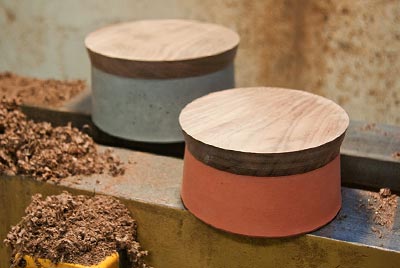

Yesterday I spent some time turning wood lids for the concrete salt cellars I’ve been working on. Woodworkers call this wood Claro Walnut (Juglans Hindsii), but it’s also known as Northern California Walnut because it grows around these parts. Unfortunately it’s seriously endangered, so either don’t use it, or use it while you still can, depending on your point of view (at least it’s local). It turns beautifully, smells wonderful, has gorgeous grain, and a nice deep brown color.

The first step is to cut a board into squares a bit larger than the diameter of the lids. Then glue up a block that the face plate can screw into. It’s kind of important to use plywood or solid wood, and not MDF because it doesn’t hold screws for shit. Let the glue dry completely before turning.

Screw on the face plate using the longest screws possible, without screwing into the piece you want to keep. Center the face plate, pre-drill the holes, and gently screw it into place, making sure they’re all tight.

Screw the face plate onto the lathe and get your tools ready. I turned these at a low speed (500 – 600 rpm), using three cutting tools and finishing them with sandpaper. The first thing to do is to make the square block into a round disc using a large gouge and taking very light cuts to prevent the tool from catching and tearing out a huge chunk of wood.

Use the gouge to get the side sloped down and a parting tool to cut in the lip that fits inside the container. At some point you will want to make some marks with a pencil so you know how deep to cut, and it’s best to get the final size by test fitting the container onto the piece, over and over and over until it’s perfect.

The next thing I do is put a dish in the bottom of the lid using the rounded cutting tool in the picture. This dish makes the lid like a small serving thing and it looks nicer than a flat surface. After this, the piece can be sanded.

The glued on blocks have to be cut off, as close to the lid as possible, and then that’s sanded away using a disc sander. This is tricky because the lid isn’t very thick, so it’s hard to hold onto. The idea is not to sand your finger tips off while flattening the top of the lid. Also don’t breathe the dust.

This is a wood lathe.

These are the lids from yesterday, although they’re a bit thicker than the original and need to lose about 1/8″ off the tops.

The fit is good, and they’ll do their job of keeping dust off the salt. The scoop is a piece of eucalyptus bark.
